Example Title
Konark Festival Where Architecture Meets Rhythm
Every December, this 13th-century stone marvel transforms into a living stage, where timeless architecture meets living art.
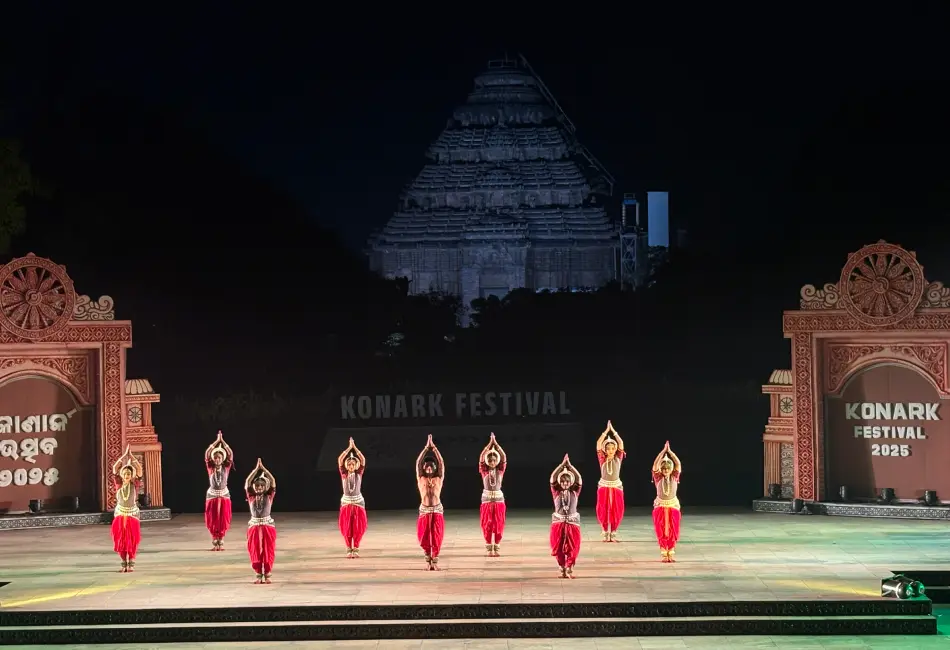
The Konark Festival is a distinguished celebration of India's classical dance and music traditions, held in the shadow of the iconic Sun Temple of Konark, a UNESCO World Heritage Site.
As dusk descends and the temple is bathed in golden light, the open-air theatre resonates with rhythmic footwork, temple bells, and classical ragas. The festival creates a rare cultural dialogue between sculpted dancers carved in stone and artists who carry forward the same traditions through movement and music.
Cultural Significance
Today, the Konark Festival stands among the most significant Indian classical dance festivals in December and a highlight of Odisha's winter cultural calendar.

The Inaugural Evening
The festival opens with ceremonial lamp lighting, followed by a premier Odissi dance performance, Odisha's own classical form that finds its earliest visual references on the temple walls themselves. The grace, tribhangi posture, and sculptural precision of the dancers echo the carvings of the Sun Temple, setting an elevated tone for the days ahead.
- Traditional lamp-lighting ceremony
- Odissi dance at the Sun Temple backdrop
- First illumination of the monument for the festival
The National Stage
The festival widens its canvas to showcase India's diverse classical heritage. Renowned artists present performances in Bharatanatyam, Kathak, Manipuri, Kuchipudi, and other classical styles, accompanied by live Carnatic and Hindustani music. This convergence transforms the Konark Festival into a national platform for classical arts, attracting scholars, connoisseurs, and performers from across the country.
- Cross-classical dance performances
- Live vocal and instrumental concerts
- National-level artistic collaborations
The Legacy of Odissi
This day is devoted to the evolution of Odissi dance, tracing its roots from temple rituals to the proscenium stage. Performances often draw inspiration from the Natya Mandap of Konark, the temple's dedicated Dancing Hall, whose walls are adorned with thousands of sculpted dancers frozen in rhythmic poses. Through expressive Abhinaya, mythological narratives, and nuanced choreography, dancers bring the stone sculptures to life, reviving the original purpose of sacred movement within temple spaces.
- Odissi repertoire inspired by temple iconography
- Mythological and spiritual storytelling
- Scholarly interpretations of Konark's dance heritage
Sand Art & Shorelines
While the classical stage glows at night, the daytime experience shifts to Chandrabhaga Beach, where the International Sand Art Festival of Konark unfolds. Renowned sand artists from India and abroad create monumental sculptures addressing cultural, environmental, and contemporary themes. Alongside this, the Konark Crafts Mela showcases Odisha's traditional arts, including Pipli Chandua appliqué work, Pattachitra paintings, stone carvings, and handloom textiles, offering visitors a complete cultural immersion.
- International Sand Art Festival of Konark
- Konark Crafts Mela and artisan showcase
- Beachside cultural walks and photography
The Grand Finale
The festival concludes with a thoughtfully curated closing ceremony that often blends classical purity with contemporary interpretations. Fusion performances, recognitions, and final recitals leave audiences with a sense of fulfillment and quiet reverence. As the illuminated Sun Temple stands witness once more, the Konark Festival closes not with spectacle alone, but with a lasting cultural imprint.
- Grand concluding performances
- Artist recognitions and cultural tributes
- Final illuminated view of the Sun Temple
Essentials Cheat Sheet
An Immersive Cultural Aura
What sets the Konark Festival apart is its open-air theatre ambiance. The cool December breeze, the rhythmic echo of percussion, and the distant sound of waves from the Bay of Bengal enhance the acoustic and emotional experience making each performance feel both intimate and monumental.
The festival is not merely an event; it is an exploration of how architecture, environment, and performance coexist in Odisha's cultural philosophy.
Glimpses of Celebration